Travelling by train as a climate-friendly alternative is becoming increasingly popular. But travelling by train in Europe is much more than just a sustainable way of getting from A to B.
Read more after the ad
Read more after the ad
It's an experience where travellers can visit historic stations, travel through enchanting landscapes and enjoy spectacular views from viaducts and bridges. Best of all, there is a trip to suit every budget and time frame.
In Lonely Planet's Train Travel in Europe guidebook, you'll find a comprehensive collection of historic, spectacular and adventurous train routes in Europe. We have selected the ten most beautiful ones for you.
1. from Paris to Berlin
Fast or slow, that's the question here: a well-developed network of high-speed trains connects the two major cities of Paris and Berlin, but those with more time in their luggage can also choose from numerous slower options. If you want to see a lot, "Lonely Planet" recommends a three-country tour from Paris via Brussels to Cologne.
Read more after the ad
The highlight of the route is Liège-Guillemins, the futuristic station in Liège. In Cologne, while waiting for the ICE to Berlin, you can visit the cathedral, which is right next to the station. It takes five hours to get to Berlin by ICE from Cologne. You can book tickets for the various routes at Trainline, for example.
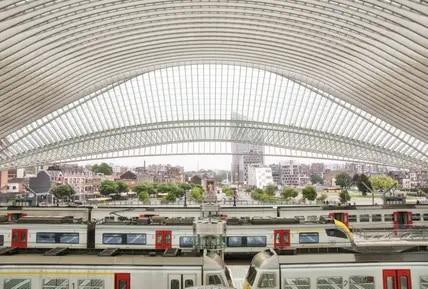
The Liège-Guillemins station in Belgium is without doubt the architectural highlight of the Paris-Berlin route.
© Source: imago images/Zoonar
2. from Innsbruck to Garmisch-Partenkirchen
Admittedly, at around three hours' drive, this route connecting Austria and Germany is rather short. But in return, a magnificent Alpine panorama awaits you with glistening lakes, deep green forests and snow-covered mountain peaks.
In Garmisch-Partenkirchen, you can change to a rack railway and take the train to Germany's highest mountain, the Zugspitze. Also worth a visit is Ambras Castle in Innsbruck, which you could visit as a prelude to the two-country trip.
Read more after the ad
Read more after the ad

You can take a rack railway to Germany's highest mountain, the Zugspitze.
© Source: imago/Loop Images
3. from Amsterdam to Vienna
Let yourself be lulled to sleep by the gentle jolt of the train and wake up the next morning relaxed in another European city? You can experience this, for example, with the Nightjets of the Austrian Federal Railways (ÖBB). ÖBB recently started offering the Amsterdam-Vienna route, which takes around 14 hours.
The trains leave Amsterdam every evening at 7 p.m. or 7.30 p.m. and arrive in Vienna at 9.19 a.m.. Perfect, then, to start the day with breakfast in one of Vienna's famous coffee houses.
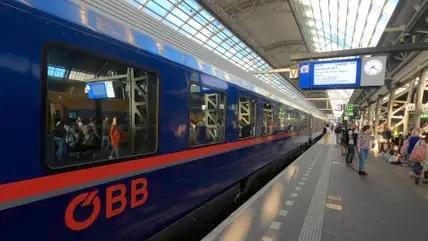
The journey with the ÖBB Nightjet from Amsterdam to Vienna takes around 14 hours.
© Source: imago images/Richard Wareham
Read more after the ad
Read more after the ad
4. from Budapest to Split
A night train connects the Hungarian capital Budapest with the Croatian city of Split during the summer months. In recent years, the train has departed Budapest at midnight and reached Split, located in southern Croatia, around noon.
The route passes Hungary's Lake Balaton, the largest inland lake in Central and Western Europe, and the Croatian capital Zagreb, which is perfect for a stopover. Split is on the Adriatic coast and from here there are buses to Dubrovnik and ferries to the surrounding islands.

A night train runs in summer from Budapest via Zagreb to Split in southern Croatia.
© Source: imago images/imagebroker
5 From Oslo to Bergen
You might think how fast time flies on the train when you take one of the most beautiful train rides in Europe. The Bergen Railway (Bergensbanen) in Norway runs from Oslo to Bergen, past stunning Nordic scenery.
Read more after the ad
Read more after the ad
Forests and lakes line the route, the train passes Finse, the highest station in Northern Europe at 1222 metres, and finally there are impressive views of fjords and waterfalls. There are several connections daily and the journey takes seven hours.

The train journey from Oslo to Bergen takes you through the wild Nordic mountain landscape with fjords, waterfalls and deep forests.
© Source: imago images/Imaginechina-Tuchong
6 From Rome to Venice
A night train operated by the Italian railway Trenitalia connects two of Italy's top cities: the Eternal City of Rome and the lagoon city of Venice. The InterCityNotte departs daily at 10.35 pm from Rome Termini heading north. The train quietly jogs in the dark through the picturesque regions of Lazio, Umbria and Tuscany.
It is a pity that you can hardly see anything of the beautiful landscape because of the darkness, but an extraordinary experience awaits you in the morning: the train ride through the lagoon to Venice at sunrise is unique.

The night train from Rome to Venice arrives early in the morning, so you can experience the lagoon city almost deserted.
© Source: PantherMedia / Andrey Omelyanchuk
Read more after the ad
Read more after the ad
And when you arrive in Venice at 6.25am, you'll encounter almost deserted streets. How about a first stroll through the city and a strong espresso?
7 From Dublin to Madrid
You'll have plenty of time to enjoy the scenery and socialise with fellow travellers on the "slow trip" by train and ferry from Dublin to Madrid. After all, the entire route takes a good 38 hours. From Dublin, it's a three-hour journey along the Irish Sea to the port of Rosslare, where a ferry leaves twice a week for Bilbao.
On the train journey you will also pass the picturesque town of Wexford on the River Slaney. The ferry trip across the Atlantic takes around 30 hours, and from Bilbao it's another five hours by train to Madrid. On the way, a stop in Burgos with its beautiful cathedral is worthwhile.

On the journey from Dublin to Madrid you will pass the picturesque town of Wexford.
© Source: imago images/Walter Bibikow
Read more after the ad
Read more after the ad
8 Corsica: From Ajaccio to Bastia
A narrow-gauge railway runs across the French island of Corsica. The three main lines of the Corsican Railways (Chemins de Fers de la Corse) run between Ajaccio, Calvi and Bastia. The line from Ajaccio to Bastia is the longest and perhaps the most beautiful on the island.
The train travels from coast to coast, through dense, fragrant maquis and lonely, rugged mountain landscapes. Again and again there are great views of Corsica's diverse and wild nature. The drive takes a good three and a half hours.
The best way to reach Corsica is by ferry from the French ports of Toulon and Nice. Corsica is also easy to reach from the Italian cities of Savona and Livorno.

On the train ride from Ajaccio to Bastia you can experience the diverse Corsican landscape.
© Source: imago images/Jan Wlodarczyk
9 From Paris to Barcelona
Of course, there are high-speed trains that take you from Paris to Barcelona in about six and a half hours. But how about taking more time and choosing the slower option viaToulouse and Latour-de-Carol? You can expect a leisurely journey through the Pyrenees with fantastic views of the mountains.
Read more after the ad
Read more after the ad
From Latour-de-Carol, a regional train takes you to Barcelona in three hours. To stretch your legs in between, "Lonely Planet" recommends stops in the medieval Ribes de Freser and in Ripoll, where there is a monastery worth seeing and numerous hiking opportunities.

The train journey from Paris to Barcelona takes you through the scenic Pyrenees.
© Source: imago images/Andia
10 Scotland: From Glasgow to Mallaig
Harry Potter fans take note: If you take the West Highland Line from Glasgow to Mallaig, you'll feel like you're on the Hogwarts Express. Deep green forests from which mist rises, wide moors and mirror-smooth lochs line the route. The absolute highlight: the train travels over the Glenfinnan Viaduct - just like in the Harry Potter films.
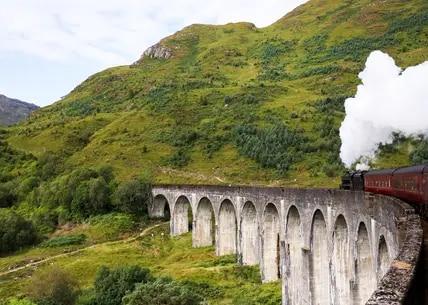
You might know it from the Harry Potter films: the Glenfinnan Viaduct in Scotland.
© Source: imago images/phaendin
Read more after the ad
Read more after the ad
The journey takes a good five and a half hours. The link passes through one of the most remote corners of Scotland, where there are only small clusters of houses every few miles and hardly any roads. Pure adventure!